This receipt records the expanded Iris memory and recall guide. The guide grows from eleven to forty-four slides while preserving every established slide identifier and its prerequisite after contracts and tenancy.
The sequence follows one fictional member preference from a Psyche turn through the assistant shell and Iris. It explains evidence posture, entry anatomy, all twenty-nine categories, the nineteen-category sensitive set, eight canonical and eleven adapter scopes, per-scope policy, retention, promotion, decay, compaction, recall gates, the four-factor ranker, audit envelopes and surface budgets. It corrects the documented decay label: thirty days is an exponential time constant, giving a recency factor near 0.368, while the half-life is about 20.8 days.
The second half separates entry consent from consent-ledger history, append from full validation, inference from member authority, and write conflict policy from recall freshness. It then teaches privacy suppression, delete/export/access rights, statutory clocks and result fingerprints, the intended but partial member controls, multi-actor masking, content-free continuation tokens, cross-device conflict, inspection lifecycle and policy, snapshot replay, audit, member notice, the shell bridge and release-evidence boundaries.
Every meaningful unit in V1/architecture/substrate-iris.md and
V1/features/iris-memory-identity.md is reviewed: six existing assignments plus
49 new fingerprint-bound assignments. One parent heading remains structural.
The Iris increment adds 49 reviewed units. With the concurrent Arete checkpoint
integrated, global teaching coverage is 347 reviewed units, with 10,018
structural and 102,979 unassigned units across the broader repository inventory.
The final browser report records 308 assertions, 143 captures, zero fit findings, four rejected negative controls and zero page errors across standalone 1440, 1280, 390 and 320 pixel readers and expanded, collapsed and mobile embedded states. Visual review found and corrected hidden recovery states, accidental ordinals and two compact-reader overflows before the final pass. The Center report records 14 integration checks, 88 embedded slide captures, two audio boundaries, 87 unchanged-guide continuity checks and a fresh 44-page PDF. The PDF text report binds the exact authored visual text on every page.
Thirty-three new fingerprint-bound narration tracks add 38.37 minutes. The complete Iris guide runs 61.51 minutes, and the integrated library has 1,355 current tracks totaling 29.61 hours. All new tracks pass byte, hash, duration, decode and encoded-pause verification. The integrated library now has 88 guides, 1,355 unique slides, 1,378 guide-slide instances and 658 cited paths.
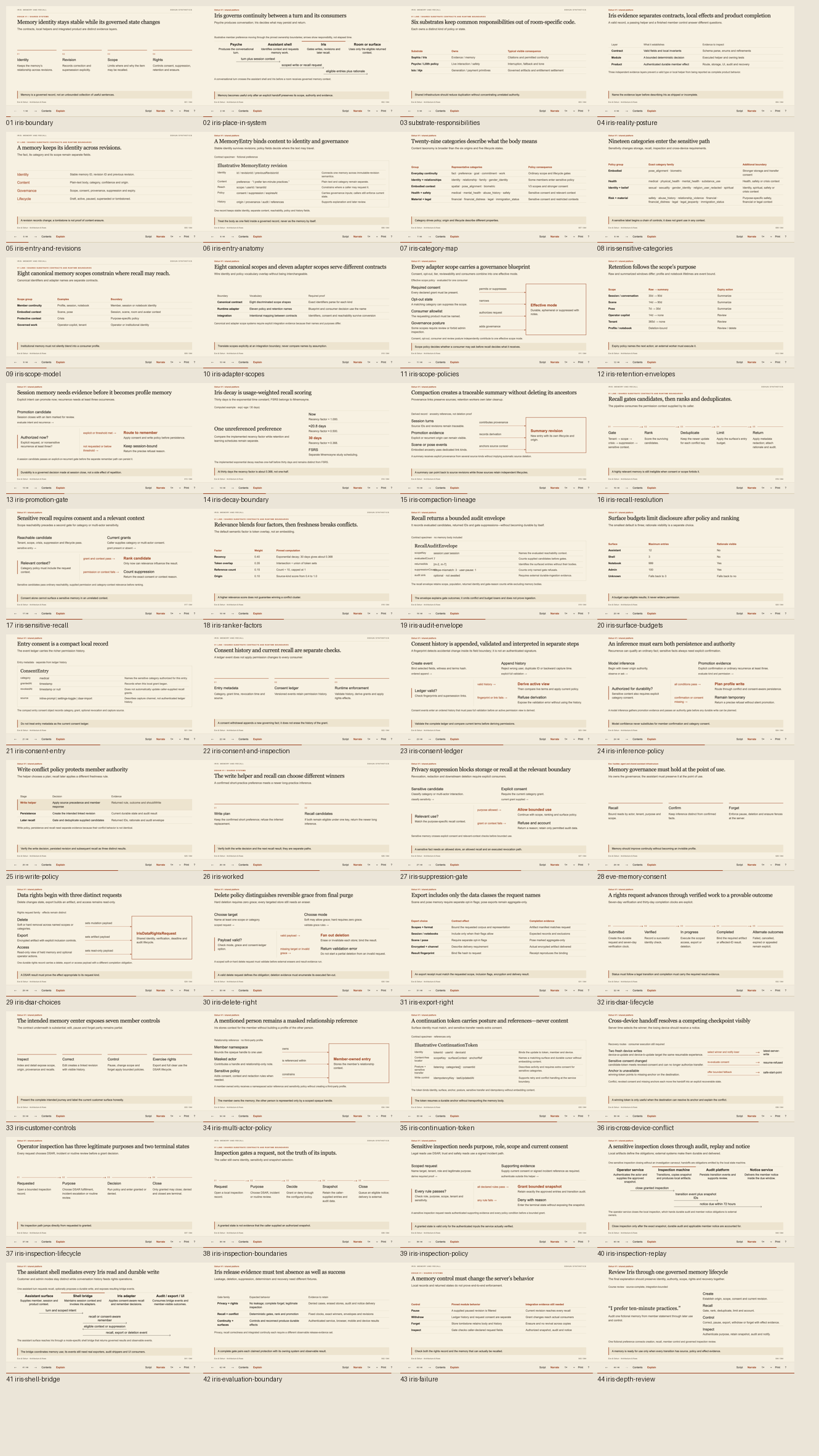
Presentation verification includes 19 builder and assignment tests, 31 executed pinned Iris module cases, generator and coverage freshness, format and lint checks. The final optical contact sheet was inspected at its 1280×720 capture scale and records the accepted sequence.
This delivery completes the two pinned V1 Iris pages. It does not establish authenticated service callers, durable memory persistence, replica and downstream erasure, audit ingestion, delivered member notices, complete web/mobile controls, cross-device execution, human comprehension or normal-speed listening. The wider Iris repository, Psyche/Lilith and remaining V1 program stay active.