Implementation/review began September 6 and verification finished September 7,
2026 UTC. This is a completed implementation increment, not an accepted pilot,
finished chart system or completed presentation library. The full goal remains
in TODOS.md. Source pin:
1ceae52c7896a59ac74a4429d410f3218f0b91c6; implementation base:
437143f485fb27557b19c824883afe5070fef122.
What changed#
psyche-latency-targets remains a table because readers need exact values for
different measurement contracts, not a ranking of unlike intervals. Seven
numeric cells and five missing entries map to four pinned latency-target
exports. The visible caption states configured milliseconds and “not configured,
not zero.” Native row/column headers, explicit accessible missing meanings,
right-aligned numbers and a visible PDF legend preserve the comparison.
The shared table validator rejects malformed dimensions/identities, numeric strings, booleans/null, nonfinite values, null metadata, ambiguous or numeric missing markers, and incomplete cited/pinned provenance. Exact legitimate zero, negative, large integer and decimal values survive the generic renderer; the actual latency example remains bound to its source constants. Configuration has no sampled population or observation window; both are explicitly inapplicable.
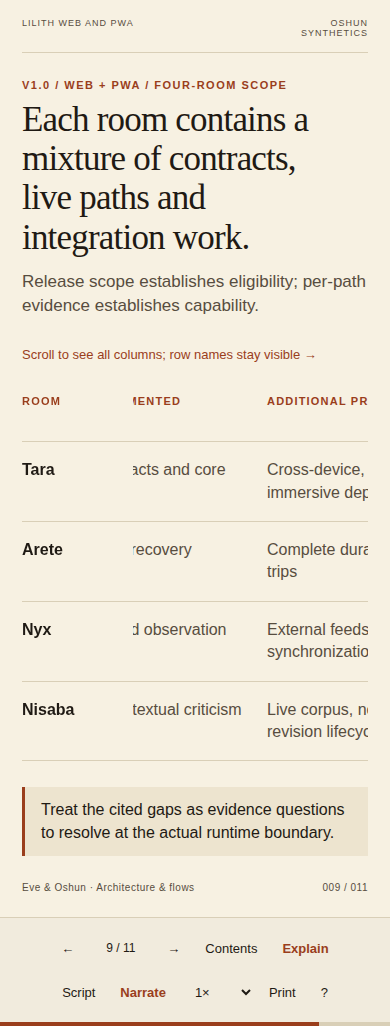
On narrow screens, the first column stays beside each readable comparison column. A 120px prose-label minimum avoids splitting “Interruption”; quantitative rows use compact widths. The quantity/unit/legend stays inside the table viewport. A resize observer hides the scroll hint when there is no actual overflow. Source dialog tables are excluded, and print retains the complete static table.
The frontend skill informed this restrained native-table choice, provisional typographic floors and actual-size review. The brief records the communication job and neutral reader tasks. No decorative chart, invented measurement or new narration was introduced.
Automated evidence#
- Python: 102 passing tests, including 14 table/PDF contract tests. Negative controls cover swapped values, changed units/kind, lost legends and missing entries incorrectly replaced by zero.
- Node: 137 passing tests, including 50 pinned Psyche tests and five isolated Lilith adapter tests. Every displayed target/missing cell agrees with the actual pinned exports. This is controlled module evidence, not a project typecheck, live provider or production-performance claim.
- Focused table matrix: 34 captures across four real guide/slide contexts, including desktop, compact, actual compact playback, 390px portrait, 320px narrow, 844px landscape and embedded mobile. Two clearly synthetic fixtures exercise long unbroken labels and zero/negative values. Native semantics, axe, padded text bounds, every narrow column, sticky row identity, caption visibility and numeric text floors pass. Deliberately disabled sticky positioning and a falsely labeled capture edge are rejected.
- Full non-draft standalone suites for web/PWA and Psyche: all 11/15 slides, desktop/compact/mobile, keyboard/history/dialog/focus/source/script behavior, accessibility, print, actual audio decode/pause/resume/seek/speed/end, HTTP failures and playback races. Both final launcher sessions exited 0.
- Complete center: 14 passing groups, 38 guides, 387 unique slides, 413 instances, 826 ordered/hash-checked embedded captures and 38 complete PDFs. All 91 table instances pass both desktop and mobile readability checks (182 reports); 18 ready guides pass 36 actual playback boundaries. The other 20 guides are omitted from audio only. This remains draft/ready-audio mode, not the full narrated release gate.
- Existing composition regression: all 49 captures pass and are byte-identical to the previous receipt. This preserves scoped prior observations, not new reader evidence or a new full-guide editorial pass.
- Static gates: builder/preview and teaching-report freshness, Ruff, scoped ESLint, normal/authored-evidence formatting and whitespace. Complete teaching correctly remains rejected: 26 reviewed, 10,018 structural and 103,300 unassigned units. The latency assignment was refreshed after source review; no new unit is counted as reviewed.
- Audio reuse: fresh script/manifest and all 176 current MP3 byte/hash identity checks preserve the preceding decode/pause evidence. No changed spoken references or regenerated audio. Counts remain 176 current, 15,834.350 seconds and 2,439 sentence segments, with 211 pending (191 stale, 20 missing). This is not a new all-track decode or normal-speed listening.
The bounded checks ran serially with the resource supervisor on a 15 GiB host with 31 GiB swap. The complete center stayed above 12 GiB available memory. No broad Nx, product-build, model-render or packaging sweep was started.
Visual review, erratum and capture integrity#
The visual ledger records model inspection of eight baseline images, 34 final table images and eight current PDF renders: each of the four target pages at 2000px and 1280px page-fit scale. Thirty final images reuse exact bytes inspected in the preceding focused run; four full-height landscape images were freshly inspected. These are 50 scoped review items, not an every-library-slide optical pass. The 49 regression images retain separate exact-byte inherited observations. Full center captures are automation evidence; they were not all model-inspected.
Retraction: the prior receipt's room-maturity desktop touching-column finding was an incorrect model observation. The baseline is byte-identical to its saved image, and actual text ranges show 195.984375px between the final row's second and third text cells. Existing right padding is 22px. No desktop padding change was warranted or made. The older receipt is left historical; mobile row-identity loss was separately reproduced and corrected.
The first focused run's far-edge PNG was not reliable evidence: taking a beyond-viewport screenshot changed the table's scroll offset from 235px to 101px despite valid pre-capture geometry. The final helper expands the viewport height explicitly at unchanged width, restores the requested scroll edge, and verifies identical cell geometry/scroll position before and after the PNG, then restores the tested viewport. Both viewport sizes are recorded. Full-height reading images are not initial-phone-viewport fit claims; actual embedded captures remain 390×741 inside the 390×844 center. The negative-control fixture correction and landscape height-convergence correction are retained as failed diagnostic runs, not passing checks. Final scoped runs use the corrected fixtures and capture method.
Remaining work includes architecture/ownership and annotated-artifact treatments, the remaining complete web/PWA guide migration, generic Psyche opening, misleading legacy ordinals/arrows, complete typography/font and chart/image standards, normal-speed listening, willing-reader sessions, benchmark promotion, source expansion and whole-library adoption. No human comprehension, general chart acceptance or full-goal completion is claimed.
Reproduce#
After installing the documented dependencies, use a distinct output directory for each run, and review host resources before expensive checks:
python -m unittest discover -s tools/presentations/tests -p 'test_*.py'
node --test tools/presentations/tests/*.test.mjs
CHROME_CHANNEL=chromium OSHUN_TABLE_QA_DIR=/tmp/oshun-table-new python tools/presentations/run-supervised.py node tools/presentations/tests/table-pilot.mjs
CHROME_CHANNEL=chromium OSHUN_DECK_QA_DIR=/tmp/oshun-web-new python tools/presentations/run-supervised.py node tools/presentations/tests/eve-oshun-deck.mjs --guide v1-web-pwa
CHROME_CHANNEL=chromium OSHUN_DECK_QA_DIR=/tmp/oshun-psyche-new python tools/presentations/run-supervised.py node tools/presentations/tests/eve-oshun-deck.mjs --guide psyche-lilith
CHROME_CHANNEL=chromium OSHUN_CENTER_QA_DIR=/tmp/oshun-center-new python tools/presentations/run-supervised.py node tools/presentations/tests/presentation-center.mjs --draft --ready-audio
CHROME_CHANNEL=chromium OSHUN_COMPOSITION_QA_DIR=/tmp/oshun-composition-new python tools/presentations/run-supervised.py node tools/presentations/tests/composition-pilot.mjs
Run these separately, not concurrently. State binds the tested HTML/PDF, source/authoring/renderer/test inputs and reviewed images. Raw reports and logs retain original bytes; authored prose/ledgers are formatted separately.