This is a source-backed implementation increment, not a completed pilot,
accepted benchmark or finished presentation library. The full contract remains
in TODOS.md. Source claims retain revision
1ceae52c7896a59ac74a4429d410f3218f0b91c6; the implementation base is
5ccbe776951a0bc66c81561d2810d7cc7169e858. The preceding
composition receipt is historical
and has not been rewritten.
Implemented and verified#
psyche-runtime-fallback now explains first-supplied priority directly: kill
switch, policy, accessibility, provider, quality, then latency. Only absence
continues. A supplied signal joins validation, whose valid and invalid outcomes
terminate independently. No signal keeps the current mode. Invalid current mode
throws before this depicted selection. Later constraints are neither merged nor
validated, and a returned candidate is not executed media or a safety decision.
The caller's independent safety/capability obligations remain explicit.
The native HTML/CSS priority treatment validates a content-determined condition count, exact labeled edges, terminal roles and reading order. Narrow layouts retain full named destinations and accessible relational text. Pure pinned-module tests compare all 64 signal subsets in three current modes (192 cases), reject six malformed selected signals without fallthrough and test invalid current mode. This is not service, provider, authorization or live-media acceptance.
Nine regenerated recordings complete all fifteen Psyche/Lilith tracks at
1,868.740 seconds (32 minutes displayed). The current library has 176 tracks,
15,834.350 seconds and 2,439 sentence segments. 211 remain pending: 191 stale
and 20 missing. Stock Kokoro/Misaki 0.9.4, af_heart, speed 0.95, one CPU
thread and the established oh-shuhn/pause rules remain unchanged. No provider
credential or voice clone was used.
The frontend skill guided the open decision ladder, restrained emphasis and
spacing-only compact fix.
All eleven web/PWA slide briefs now
record narrative jobs, evidence, relationships, emphasis, reading order and
transitions. These plans explicitly account for effective diagrams.json
overrides: release enforcement is already a fan-out graph. Its proposed work is
ownership labels and exceptions, not replacement of an unseen fallback flow. The
remaining guide treatments are not implemented by writing their briefs.
Automated evidence#
- Python: 88 passing tests, including eleven new decision contract cases and the complete-guide brief/order guard.
- Node: 136 passing tests, including 49 pinned Psyche and five isolated Lilith adapter tests. Pinned TypeScript module execution is not a TypeScript project typecheck.
- Static gates: builder/preview and teaching-report freshness, Ruff, scoped ESLint, ordinary and authored-evidence formatting, and whitespace checks. The complete-teaching gate correctly exits 1: 26 reviewed, 10,018 structural and 103,300 unassigned units remain.
- Full non-draft standalone checks for Psyche and web/PWA: all 15/11 slides, desktop/compact/mobile, source and transcript alignment, keyboard/dialog/focus behavior, axe, print, actual audio decode/pause/resume/seek/speed/end, missing/corrupt HTTP audio, recovery and playback races.
- Focused matrix: 49 final captures across four guide/slide contexts; semantics, provisional label floors, overflow, scrolling, font readiness/fallback and accessibility. Four compact-playing states use actual audio; the long-label fixture is explicitly synthetic.
- Complete center: 14 passing groups, all 38 guides, 387 unique slides, 413 instances, 826 ordered/hash-verified embedded captures and all 38 delivered PDFs with complete page sequences. All 18 fully narrated guides pass 36 desktop/mobile audio boundaries. Twenty incomplete guides are excluded from audio, not layout/PDF coverage. This remains draft/ready-audio mode, not the fully narrated release gate.
- Current audio audit: all 176 current MP3s checked for script fingerprint, bytes, SHA-256, actual decode, duration and encoded sentence/paragraph pauses. It does not claim normal-speed listening.
Both bounded narration launcher sessions returned 143 despite five/four complete
render entries in batch one and batch two.
The termination cause was not established; those launcher statuses are not
reported as passes. Actual children were checked until terminal, the first five
tracks separately passed renderer --check, and the subsequent complete
176-track audit passed. Artifact verification and full browser playback, not a
launcher success assumption, establish the current audio evidence.
Verification used serial targeted commands on a 15 GiB RAM / 31 GiB swap host, with about 13 GiB available and 14 GiB free on root/tmp. Other sessions were left alone; no broad workspace builds were run. The supervisor/narrator and manual checks monitored memory; the separate first-batch resource-log watcher ended early, so no uninterrupted top-process log is claimed. No resource-pressure failure was observed. The toolchain was Python 3.12.3, Node 24.15.0, Playwright 1.60, Chromium 148.0.7778.96, axe 4.11.4 and Poppler/FFmpeg.
Visual evidence and unresolved findings#
The visual ledger binds 143 image files: 56 newly inspected at original detail and 87 inheriting observations only through exact PNG equality. Image comparisons preserve the explicit previous paths; byte equality is not new reader, source or listening evidence. The 56 inspected files comprise eight before, twelve pre-audio, eighteen changed/new final focused, four changed Psyche guide, eleven web/PWA desktop, two contact-sheet and one 1280px runtime PDF page-fit image.
Focused normal contexts are standalone 1440×900, 1280×720, 390×844 and 844×390; embedded expanded/collapsed desktop, compact and mobile use the same outer viewports. Reports retain actual frame dimensions, including 988×617 compact and 390×741 mobile. DPR is 1 and browser zoom 100%; reduced motion is enabled. The 32px CSS/generic-font stress is not browser-wide 200% zoom. Compact embedded and mobile content remains vertically scrollable, with end captures proving access to the conclusion and controls. PDF inspection covers the current runtime page at 2000px and at 1280×720 page fit; other Psyche PDF views inherit prior observations only where PNG bytes match.
The failed full Psyche run exposed a real active-playback height regression:
727.859375px in a 720px viewport. Its
diagnostic report and
log are retained as failed evidence,
not a passing gate. Scoped .has-audio section/caption gaps fixed it without
reducing label sizes. Full non-draft reruns and all four focused compact-playing
captures pass and were inspected.
The complete web/PWA and Psyche thumbnail sequences were inspected for rhythm, separately from actual-size review. They expose remaining work: repeated account/design columns; PWA install/cache/update/clear arrows that imply a compulsory lifecycle; the existing release graph's unlabeled edges; Psyche's generic four-column opening; and recurring legacy flow shapes. The room-maturity table's final substrate text touches the next column in the 1440px desktop view. Its cell separation needs correction and regression coverage; page overflow/axe passing does not establish optical spacing. Quantitative dash meaning, mobile table row identity and worked-trace double numbering remain open from the prior review.
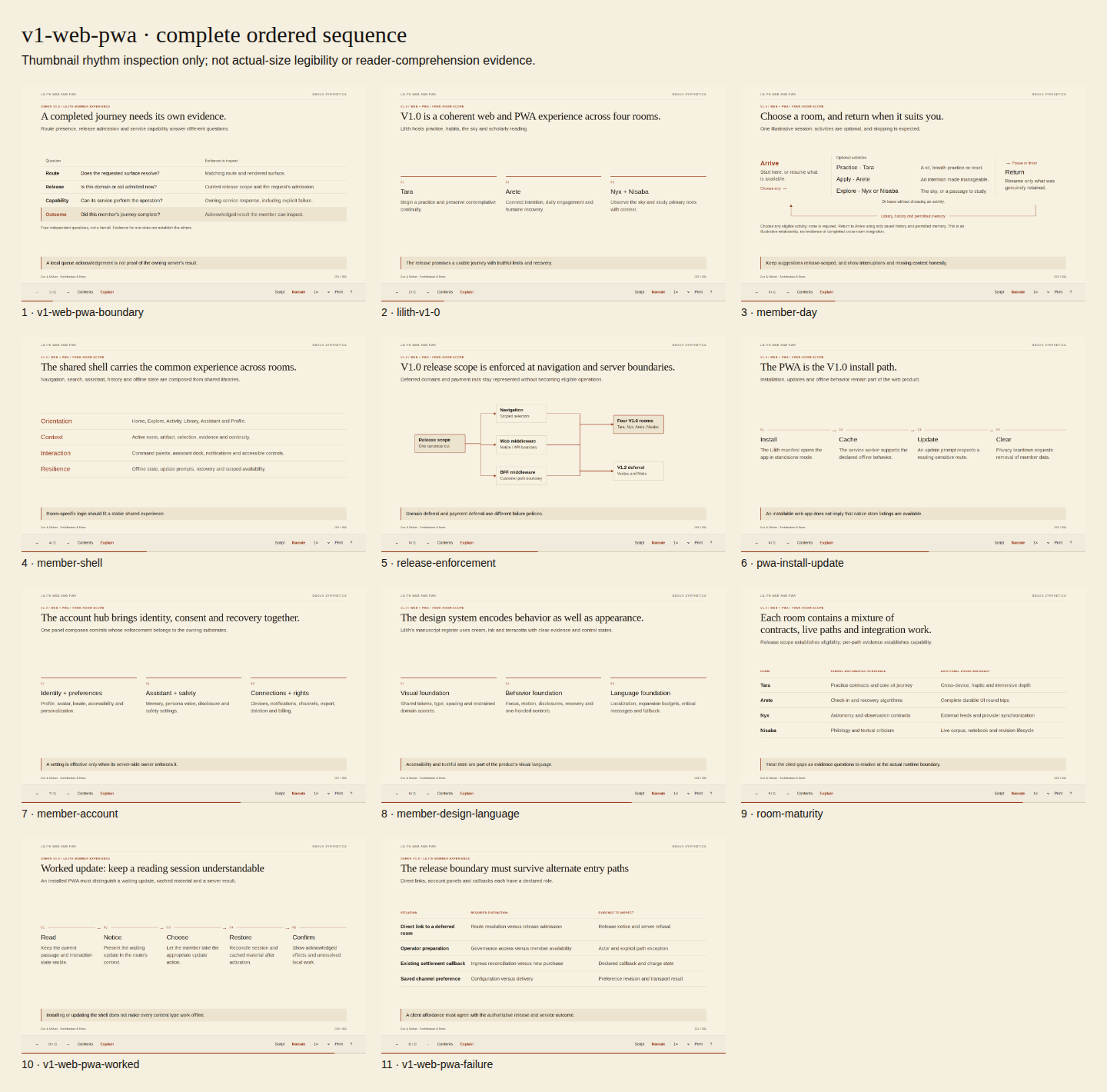
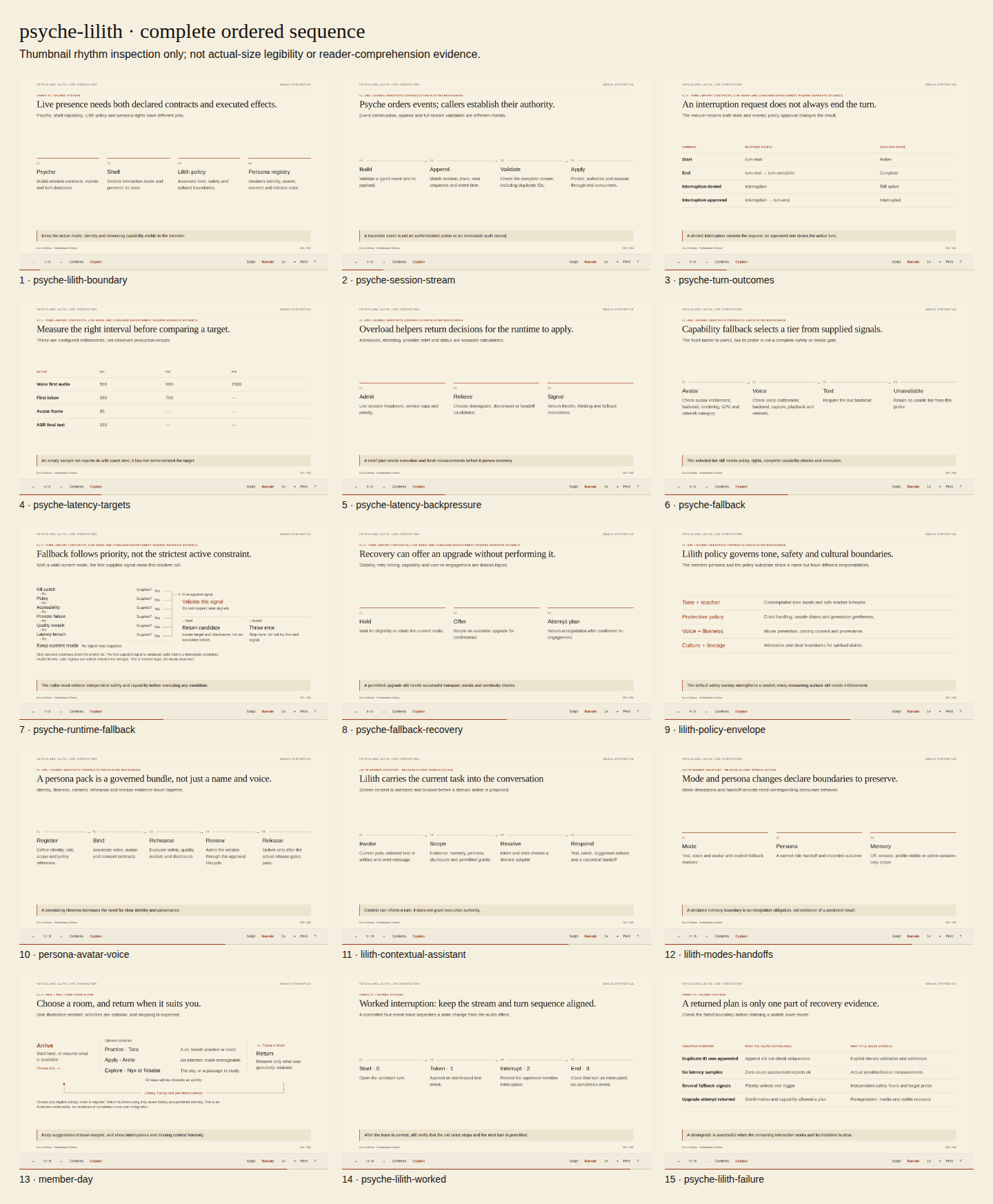
All eight craft standards are scoped in the ledger. No willing-reader results, normal-speed listening, complete type/font specification, quantitative/artifact pilot acceptance, projection test or whole-library optical pass is claimed. Neutral runtime-reader tasks exist in the protocol, but no participants or comprehension outcomes have been invented.
Reproduction and hash boundaries#
Use the repository's resource checks before expensive commands and run browser jobs serially, in separate output directories. With the documented Python and browser dependencies installed, the relevant commands are:
python -m unittest discover -s tools/presentations/tests -p 'test_*.py'
node --test --test-concurrency=1 tools/presentations/tests/*.test.mjs
python tools/presentations/build-eve-oshun.py --check --preview
python tools/presentations/check-center-coverage.py --check
CHROME_CHANNEL=chromium OSHUN_COMPOSITION_QA_DIR=/tmp/priority-pilot-recheck \
  python tools/presentations/run-supervised.py node tools/presentations/tests/composition-pilot.mjs
CHROME_CHANNEL=chromium OSHUN_DECK_QA_DIR=/tmp/priority-psyche-recheck \
  python tools/presentations/run-supervised.py node tools/presentations/tests/eve-oshun-deck.mjs --guide psyche-lilith
CHROME_CHANNEL=chromium OSHUN_DECK_QA_DIR=/tmp/priority-web-recheck \
  python tools/presentations/run-supervised.py node tools/presentations/tests/eve-oshun-deck.mjs --guide v1-web-pwa
CHROME_CHANNEL=chromium OSHUN_CENTER_QA_DIR=/tmp/priority-center-recheck \
  python tools/presentations/run-supervised.py node tools/presentations/tests/presentation-center.mjs --draft --ready-audio
Use unused directories for new evidence. Full center runs regenerate the delivered PDFs, so later exports invalidate this receipt's PDF hashes even if the visible pages are unchanged. The 826 full-center PNGs remain reproducible temporary review inputs; selected original PNGs are retained here. Historical before/pre-audio reports intentionally bind earlier artifacts, not current HTML.
checks.json binds current implementation/source inputs, all delivered PDF bytes and every retained evidence file except itself. Its verifier also checked report scope, current input hashes, the 826 temporary capture hashes, all current MP3 hashes, reviewed-image dimensions/provenance, static results and teaching freshness. Hashes prove which files were checked, not that unfinished editorial or full-goal requirements have passed. The complete teaching and fully narrated release gates must still pass at final completion.