September 7, 2026 UTC. Source pin: 1ceae52c7896a59ac74a4429d410f3218f0b91c6;
implementation base: a30f4eaeea7d52de95b9b0375f82bc4944fbbbe3. This is a
composition-pilot increment, not an accepted benchmark or completed library. The
full objective remains in TODOS.md.
Meaning and implementation#
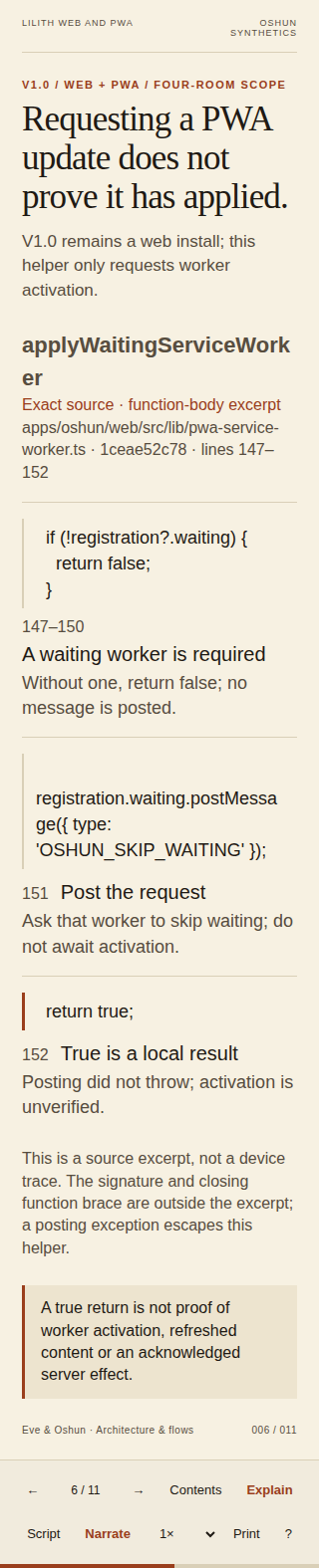
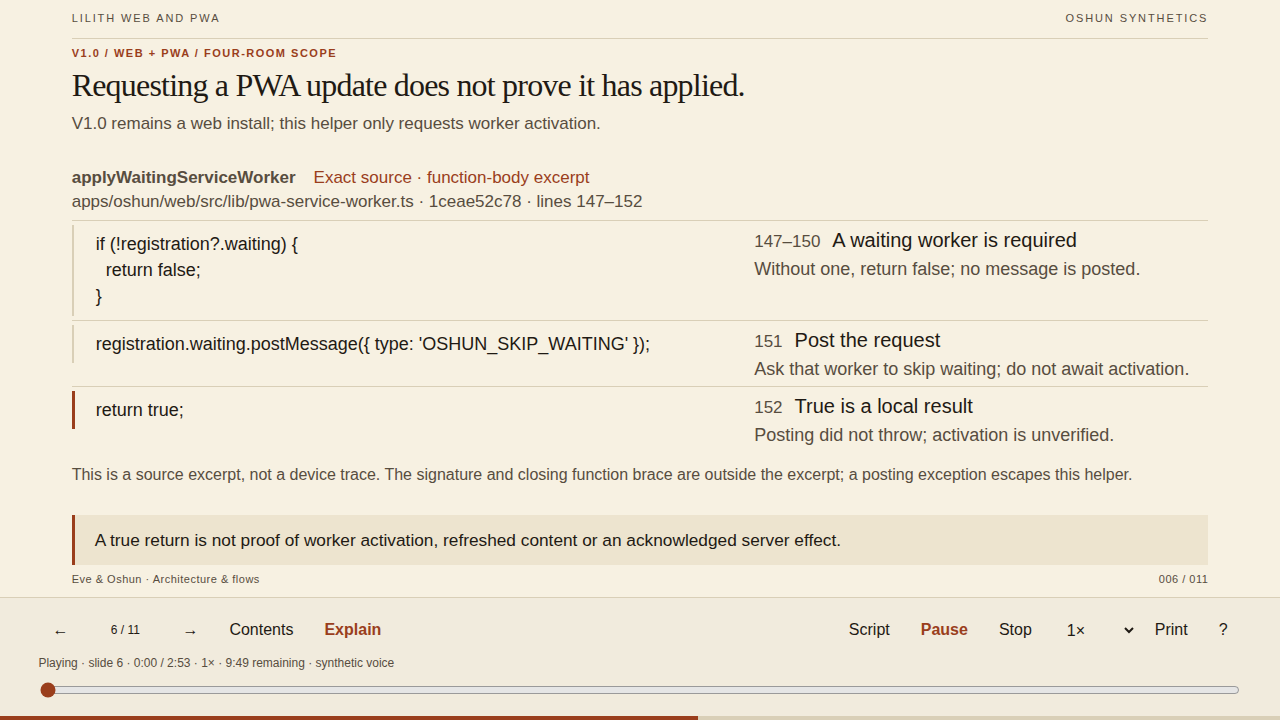
The existing pwa-install-update slide now shows exact lines 147–152 of
applyWaitingServiceWorker. Its absent-worker guard returns false; a waiting
worker receives OSHUN_SKIP_WAITING, followed by an immediate true return.
Posting exceptions escape, and repeating a call can post again. None of these
local results proves worker activation, refreshed content or a server effect.
The signature and final function brace are explicitly outside the excerpt.
The earlier Install → Cache → Update → Clear arrows implied a lifecycle the source did not establish. The new visual makes a narrower mechanism concrete, while preserving the installation/native-release, reading-context, queue and privacy explanations in the notes. This is a changed teaching focus, not merely new geometry for identical visible copy. Stable IDs, the eleven-slide guide order, source pin and four citations remain unchanged.
The frontend skill informed the artifact-led hierarchy, native code/annotation bands, sparse rules and single returned-result emphasis. Code and interpretation remain separate, with source line ranges and accessible bindings. Builder validation compares the specimen with the pinned Git bytes; annotations must partition its complete source range. One annotation is valid when appropriate; no fixed count or artificial directed graph is required.
Actual review led to two further corrections. Compact playback inherited a 17px
symbol style; a scoped 22px rule restores its intended role. At 320px,
identifiers broke into short trailing fragments. Native wbr opportunities at
identifier/path boundaries improve wrapping without inserting characters; source
ranges stay together. Code and annotation bodies remain 18px, headings 20px and
source labels 16px. These are provisional engineering floors, not
reader-validated typography thresholds. Earlier repeated location rows and
redundant prose were removed before tightening compact spacing.
The artifact brief, complete-guide briefs and neutral reader protocol retain the intended meaning and unfinished acceptance work. No screenshot, live worker run, willing-reader session or normal-speed listening outcome is claimed.
Verification scope#
The full presentation Python and Node suites pass 117 and 147 tests. Eight new Python cases cover exact pinned bytes, provenance, invalid ranges, variable annotation count, escaping, source-preserving wrapping, accessible bindings, speech separation, PDF order and retained installation/privacy context. Three new Node cases bind this specimen and exercise posting exceptions and repeated requests. Existing controlled helper tests cover absent/waiting workers and queue acknowledgement. They execute the pinned helper with controlled receiver dependencies, not a registered browser worker or deployed product.
The final composition matrix passes 77 captures, including thirteen source-artifact contexts. Eleven negative controls must fail and pass after restoration: four existing ownership controls plus hidden code, vertical clipping, undersized symbol, clipped annotation, altered source return, wrong visible line number and wrong source pin. Exact code characters, source line identities, symbol/path/pin/label text, annotation order, actual text bounds and role-specific sizes are checked after reflow. CSS text enlargement and forced fallback are labeled stress tests, not a browser-zoom or localization acceptance claim.
The complete eleven-slide web/PWA standalone suite passes all twelve groups: desktop/compact/mobile, accessibility, source/transcript dialogs, navigation/history, print/PDF and actual narration controls, seeking, speed, endings, missing/corrupt audio and playback races. It includes four source-artifact readability reports: desktop, compact, mobile and print.
The complete center run passes all fourteen groups: 38 guides, 388 unique slides, 414 instances, 828 embedded captures and all 38 PDFs. The 91 table instances yield 182 desktop/mobile readability reports; ownership and source artifacts each yield three screen/print reports. Eighteen ready guides pass 36 desktop/mobile playback boundaries. This is draft/ready-audio mode, not the final fully narrated release gate.
Fresh audio verification decodes and pause-checks all 177 current tracks: 16,103.359 seconds and 2,478 sentence segments. The replacement PWA track is 173.872 seconds with 24 segments. The other 176 current manifest entries and MP3 bytes are unchanged. The backlog remains 211 tracks: 191 stale and 20 missing. Decode/encoded-pause checks are not normal-speed listening or listener pronunciation acceptance.
Static checks cover the final unit suites, builder/preview and teaching-report freshness, composition audit, Ruff, scoped ESLint, formatting and whitespace. The complete teaching gate deliberately rejects the incomplete library: 26 reviewed, 10,018 structural and 103,300 unassigned units, with no invalid assignments. No product code, API, persistence or deployed runtime is modified. Controlled TypeScript execution is not a product-wide typecheck or a live PWA integration/release gate.
Heavy checks ran serially on the 15 GiB RAM / 31 GiB swap host. The center's lowest reported available memory was 12.5 GiB; no broad Nx or product build sweep was run. State binds current inputs and pinned sources; integrity binds the exact receipt files. Raw reports and logs are copied without formatting. Empty-output static checks retain their recorded exit status without an empty log file.
Optical review and limits#
The visual ledger records 59 review items: eight baseline views, thirteen final source views, 24 changed pilot regression images, eleven web/PWA desktop slides, one complete-guide contact sheet and two renders of final PDF page 6. These are model observations at original image detail, not human findings. Forty other pilot captures retain exact prior bytes and their scoped observations. The source page was reviewed at 1280px page-fit width and 2000px full-size width. Tall mobile images establish scrollable reading, not whole-slide fit inside a phone's initial viewport.
The source treatment separates guard, request and return in all inspected contexts. Thin rules and the emphasized return survive PDF export. The complete guide still has migration work: Lilith's four-room scope is shown as three numbered groups, account/design slides repeat a three-column silhouette, release enforcement has unlabeled edges, and the later worked update remains a linear five-stage explanation without visible choice branches. The new source example does not close those findings or the complete typography/reader standard.
All eight baseline and 77 final focused PNGs, and the standalone web/PWA PNGs, are retained. All 828 center PNG hashes were checked during collection; only the 22 web/PWA initial-viewport PNGs are retained here. The other 806 remain run-local automated outputs, not durable optical-review evidence. The retained pre-wrap narrow and pre-symbol-fix playback images document intermediate findings; their earlier passing diagnostic report did not include the final role-specific symbol and provenance checks.
Reproduce#
Use the prepared presentation dependencies, fresh output directories and the repository resource checks. Run expensive commands separately:
python -m unittest discover -s tools/presentations/tests -p 'test_*.py'
node --test tools/presentations/tests/*.test.mjs
python tools/presentations/build-eve-oshun.py --check --preview
python tools/presentations/check-center-coverage.py --check
CHROME_CHANNEL=chromium OSHUN_COMPOSITION_QA_DIR=/tmp/oshun-source-new python tools/presentations/run-supervised.py node tools/presentations/tests/composition-pilot.mjs
CHROME_CHANNEL=chromium OSHUN_DECK_QA_DIR=/tmp/oshun-web-new python tools/presentations/run-supervised.py node tools/presentations/tests/eve-oshun-deck.mjs --guide v1-web-pwa
CHROME_CHANNEL=chromium OSHUN_CENTER_QA_DIR=/tmp/oshun-center-new python tools/presentations/run-supervised.py node tools/presentations/tests/presentation-center.mjs --draft --ready-audio
node docs/presentations/presentation-center/verification/annotated-source-2026-09-07/verify-evidence.mjs
For a fresh decode/pause check of this receipt's current subset, pass its
comma-separated audio-current.json → current[].id list to
render-eve-oshun-narration.py --check --ids. The unrestricted narrator check
remains the final all-track gate after the backlog is rebuilt. The receipt
verifier checks saved evidence and current byte identity; it does not run
browser automation, decode audio or replace human review.